

Inspire 2025 ANNUAL DONOR REPORT
Kapiʻolani: In a Class By Itself
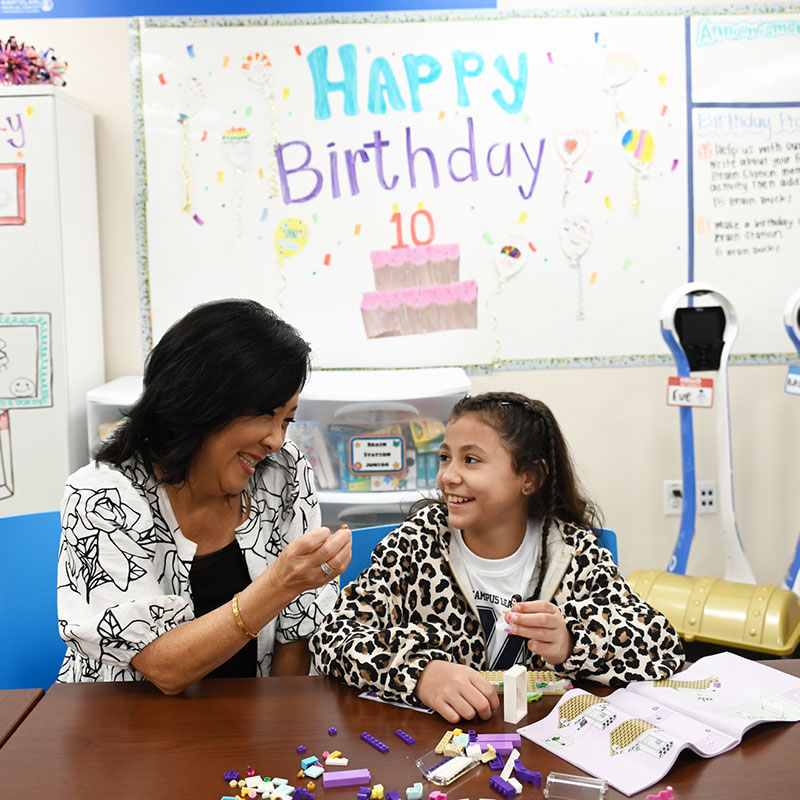

Carrie Shiraki-Sakaino, Kapi‘olani educational liaison, and student Tiffany Nakamura.
When experienced educator Carrie Shiraki-Sakaino meets with young patients and their parents at Kapi‘olani Medical Center for Women & Children, inevitably, many will share a fear that she hears time and time again.
“I don’t want to fall behind in school because I’m in the hospital.”
In some ways, the expression is actually one of hope – a moment when the child is looking toward a future beyond medication, treatment and health challenges. And Brain Station is here to help.
Shiraki-Sakaino started it as a summer literature program at Kapi‘olani in 2015. Today, 10 years later, she and Kapi‘olani-based teacher Shay Parpana create lessons for kids from elementary school through college. Unlike other hospital programs that focus on individual tutoring, in Brain Station, students work together on everything from math and science to reading and art. For kids who are often isolated because of illness, socializing is valuable.
“Our classroom provides normalcy for students who are living in a very not-normal environment,” Shiraki-Sakaino said.
Shiraki-Sakaino and Parpana are licensed special educators, skilled at adapting lessons for students with various and changing needs. They also incorporate cognitive rehabilitation strategies, such as improving and rebuilding memory, language and problem-solving functions. For students, however, it’s all about fun.
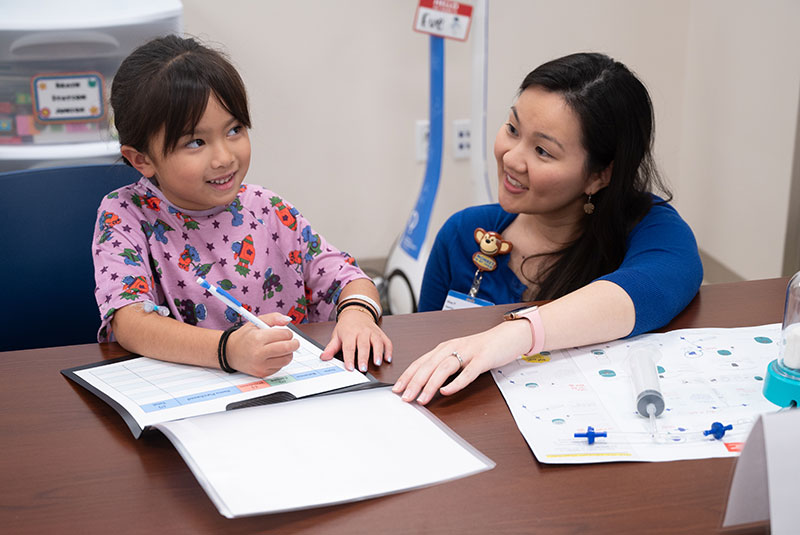
Shay Parpana, Kapi‘olani-based teacher, works with a student.
Sixth grader Tiffany Nakamura spent several months in and out of Kapi‘olani with abdominal pain and gastrointestinal issues. Her mom, Val, didn’t want her to stress about homework, but did want to keep her 11-year-old’s mind active and busy. Brain Station quickly became Tiffany’s favorite part of the day.
“I liked being here because I wasn’t stuck in my room,” Tiffany said. “I got to explore my creative side.”
“Sometimes Tiffany wouldn’t tell us everything she was feeling because she didn’t want to worry me,” Val said. “She was able to share her thoughts and express herself at Brain Station.”
“Kids at Kapi‘olani are going through so much. Having something to keep their mind off of things is invaluable.”
Supporting kids has been the focus from the beginning of the donor-funded program. Other things have changed. When Brain Station started, most work was on paper. Today, when Shiraki-Sakaino contacts patients’ schools for their homework, much of it is online, so donations to fund technical equipment are always appreciated.
The program’s influence is also growing. The team has been asked to present at conferences in Italy and Australia.
“But what’s most important is always the students,” Shiraki-Sakaino said. “Being able to put smiles on their faces and have them happy when they leave our classroom, that’s what truly inspires me.”