

Inspire 2025 ANNUAL DONOR REPORT
Wilcox: High-Tech Training
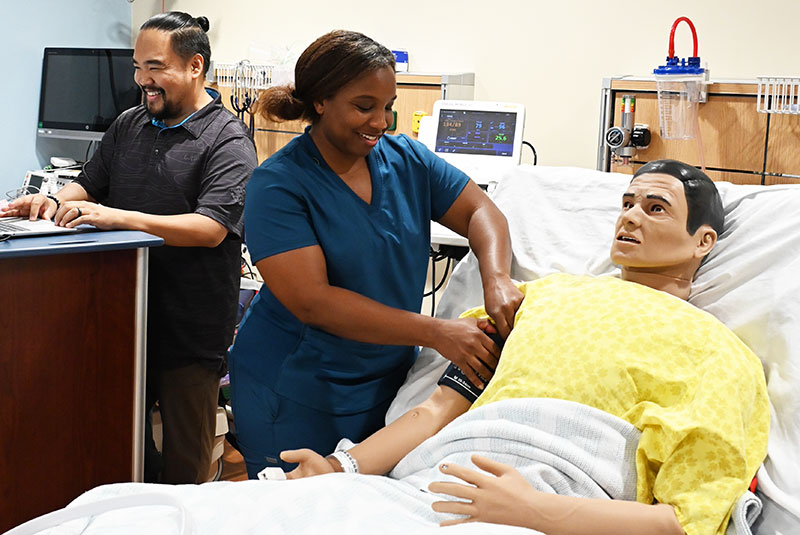

Adam Cachero (left), HPH health care simulation operations specialist, and Julene Thomas-Highfield, Wilcox nurse educator, with Kimo in Wilcox’s simulation laboratory.
Kimo is an unassuming member of the Wilcox Medical Center team. He never starts conversations. He doesn’t join co-workers for lunch. Most days, you’ll find him simply sitting quietly in a room.
And while the 5-foot-9-inch, dark-haired man never makes a fuss, he plays a big part in ensuring Wilcox teams are always ready to treat Kaua‘i patients in an emergency.
Kimo is Wilcox’s new SimMan 3G Plus manikin, a technologically advanced and more lifelike patient simulator. The 85-pound “patient” can blink, breathe, cry, bleed and respond to CPR or medication in real time. This means that Wilcox staff at all skill levels can gain experience with everything from traumatic injuries to administering IV drips and measuring blood pressure.
“Twenty-five years ago, you would maybe receive a binder with some handouts and talk about situations in class,” said Bridget Lai, RN, Hawai‘i Pacific Health associate director of clinical education. “Manikin technology allows learners to practice scenarios in a safe space, building muscle memory so that when they are treating patients, they already know how to respond.”
Wilcox is Kaua‘i’s largest medical center and the first American College of Surgeons-verified Level III Trauma Center in Hawai‘i. Now, as the first medical center in the state to have this cutting-edge manikin technology, it takes training to a new level.
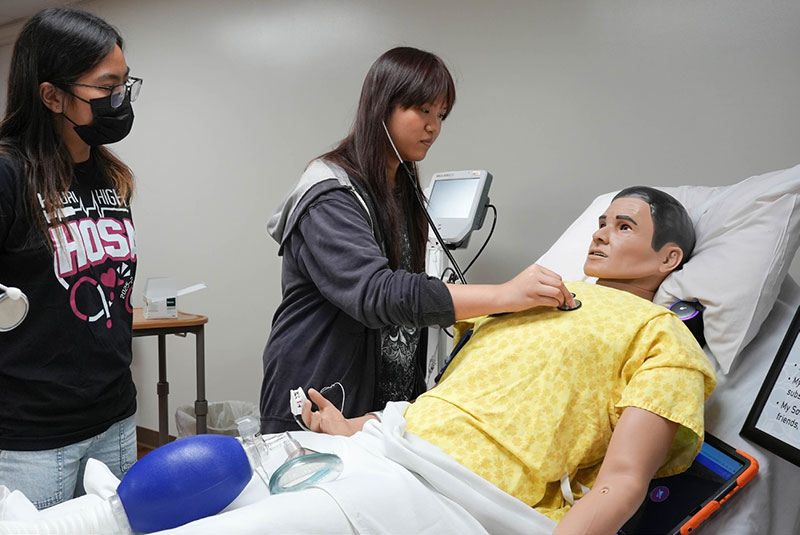
High school students listen to Kimo’s heartbeat at Wilcox’s Career Day event.
Instead of the stiff Barbie-like legs and arms of previous models, Kimo’s knees, shoulders, elbows, hips and fingers articulate more like human joints. Hard plastic skin has been replaced with silicone, which is more pliable and even “repairs” itself so that injections do not leave marks behind.
It is also customizable. The skin and other parts can be changed so teams can practice treating a man, woman or even senior citizen. Instructors can adjust Kimo’s blood pressure levels, heart rate, pulse strength and more to create fully immersive scenarios for trainees.
“Before, we had to describe situations like, ‘The patient is not blinking,’ or ‘The pupils are fixed and dilated.’ It was distracting,” Lai said. “Now we are able to focus on really what's critical at the bedside.
“The manikin can sweat, which, for patients, is a sign that something has changed. Maybe their temperature is going up. Maybe their heart rate is increasing. Maybe they are having anxiety or pain, so it is important that our staff looks for these nuanced symptoms.”
Another big advantage is Kimo’s compatibility with equipment. Earlier models came with virtual monitors and practice tools that would display simulated results. Now, the Wilcox team can train with the medical center’s actual equipment to monitor heart rates and other vital signs.
The new manikin would not have been possible without a generous grant from the Bank of Hawai‘i Foundation. Now, thanks to the foundation’s $100,000 gift, more than 200 physicians, nurses, respiratory therapists, pharmacists, nurse aides and other medical staff will train with the manikin in the first year alone. They’ll enhance both their technical skills and core skills of observation and collaboration.
“In hospitals, especially with critical care teams, communication is essential,” Lai said. “When we do simulation training, what they really benefit from is learning to work together to quickly assess patients and listen to their needs.”
It’s a valuable lesson from a patient who rarely speaks a word.